
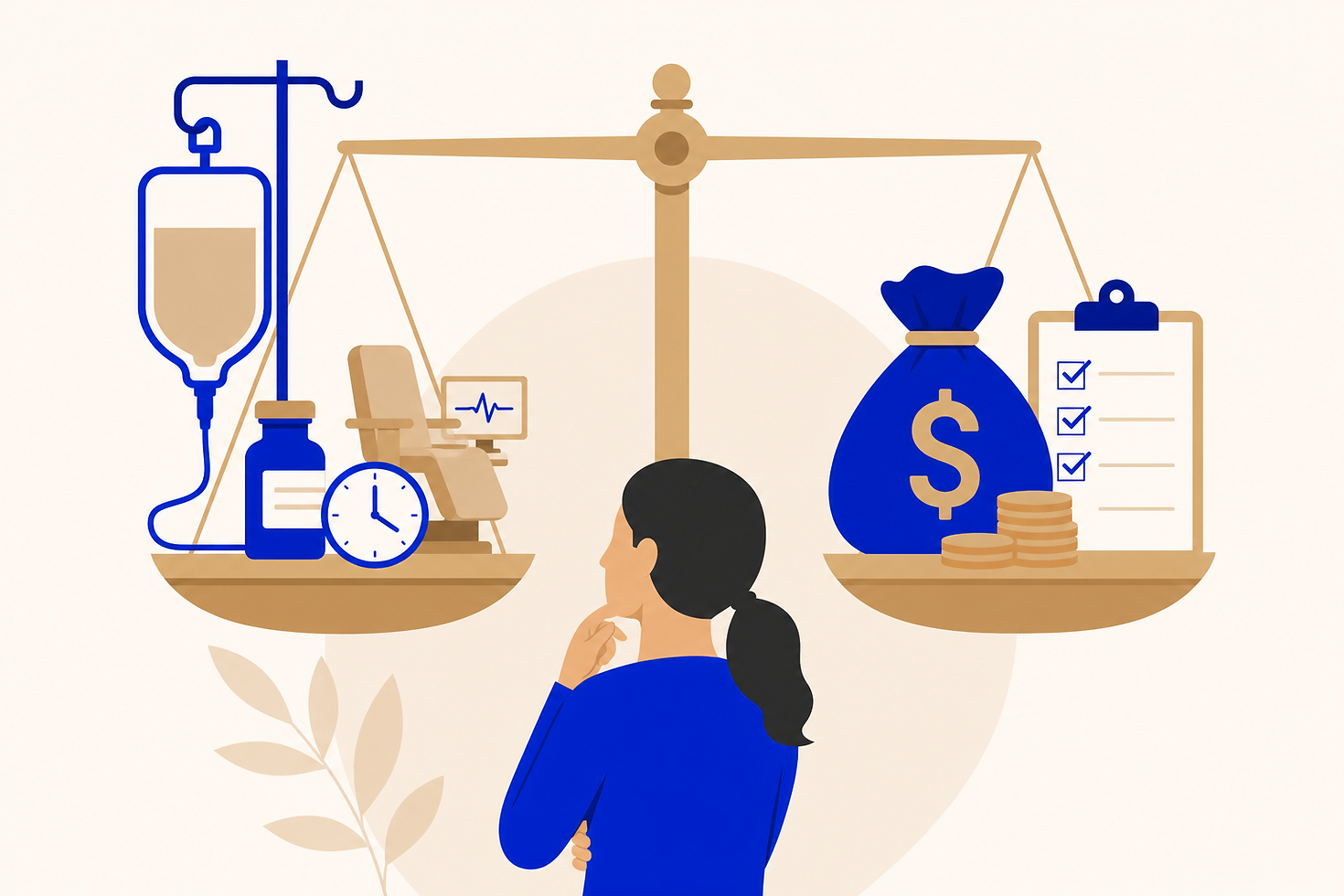
NAD+ IV Therapy Cost: Is the Price Worth It?

If you've been researching NAD+ IV therapy cost, you've already seen the range — a couple hundred dollars on the low end, well over a thousand on the high end. That spread is real. Understanding what drives it, and whether the investment holds up against the current evidence, is what this article is for.
NAD+ (nicotinamide adenine dinucleotide) is a coenzyme present in every cell of your body. It plays a central role in energy metabolism, DNA repair, and cellular signaling. Levels decline with age, and that decline has drawn serious attention from longevity researchers. IV delivery bypasses the gut entirely, putting NAD+ directly into the bloodstream. That's the premise. The price is where things get complicated.
What Does NAD+ IV Therapy Actually Cost Per Session?
The short answer: it depends on dose, clinic type, and location.
According to weightlossrankings.org in 2026, NAD+ IV drips run anywhere from $200 to over $1,000 per session. healthybodydaily.com, also in 2026, puts the typical U.S. range at $250 to $1,000, with most clinics charging between $400 and $750 for a standard 500 mg infusion. longevitycost, reporting in 2026, sets the single-session range at $250 to $1,500 and pegs a standard 500 mg dose at around $399.
An undated pricing analysis from ivinfusionfinder.com, drawing on 85 published prices across 85 providers, found a range of $50 to $1,500 per session with a median starting price of $299. The low end likely reflects clinics offering lower-dose introductory sessions or add-on pricing to other IV cocktails — not a full therapeutic NAD+ protocol.
Cost by Dose Tier
Most clinics price NAD+ IV by milligram. The dose tiers you'll encounter most often are 250 mg, 500 mg, and 1,000 mg.
250 mg: Entry-level, typically used for first sessions or sensitivity testing. Expect to pay $200 to $400 at most clinics.
500 mg: The most common standard dose. Based on the figures above, $400 to $750 is a reasonable benchmark.
1,000 mg: High-dose sessions used in loading protocols or for patients with more aggressive optimization goals. Prices at this tier frequently exceed $800 and can approach $1,500 at premium clinics.
These are benchmarks, not guarantees. A concierge clinic in a major metro will price differently than a mobile IV service.
Loading Protocols vs. Maintenance: What the Total Spend Looks Like
A single session is rarely how this therapy works in practice. Most clinics recommend a loading protocol — typically three to five sessions in the first one to two weeks — followed by monthly or quarterly maintenance infusions.
At a $500 average per session, the math looks like this:
3-session loading protocol: ~$1,500
5-session loading protocol: ~$2,500
Monthly maintenance (1 session/month): ~$500 to $750 per month, or $6,000 to $9,000 annually
Factor in a $100 to $200 consultation fee, possible mobile service fees, and add-ons like glutathione or B-complex, and a full year of NAD+ IV therapy can easily reach $8,000 to $12,000 or more for someone following a serious protocol.
That's a meaningful number. It's worth asking whether the evidence supports it.
The Evidence Question: What Do We Actually Know?
This is where the conversation has to be honest.
In 2026, a peer-reviewed systematic review — reported by the Kansas City Star — found that no human trial meeting scientific inclusion criteria had tested IV or intramuscular NAD+ for anti-aging or wellness outcomes. The review screened studies from 2010 through 2025 and identified 113 eligible studies, including 33 conducted in humans, but none of those human studies examined IV NAD+ for the energy, longevity, or cognitive outcomes most clinics are marketing.
weightlossrankings.org, also in 2026, noted that IV NAD+ drips have zero published randomized controlled trials for energy, anti-aging, or addiction. yourhealthier.com reported the same finding independently in 2026.
That doesn't mean NAD+ is ineffective. It means the specific delivery method — IV infusion marketed for anti-aging and wellness — hasn't been validated by the kind of clinical trial that would let a physician say with confidence that it works for a given indication. The preclinical science is compelling. The human IV evidence is thin.
Anyone selling NAD+ IV therapy as a proven longevity treatment is getting ahead of the data. That's worth knowing before you hand over $500 or more per session.
Why Does NAD+ IV Cost So Much?
Several factors push the price beyond the cost of the molecule itself.
Session length. NAD+ infusions run slowly by design. yourhealthier.com notes that sessions typically take two to four hours. Pushing NAD+ too fast causes nausea, chest tightness, and flushing — so the slow drip rate is non-negotiable, and it means a nurse or medical professional must monitor you for the duration. That's time-intensive for the clinic.
Compound quality and sourcing. NAD+ is a pharmaceutical-grade compound that must be prepared at a licensed compounding pharmacy. The cost of the compound itself, plus proper cold-chain handling, adds real overhead.
Clinic overhead. A physician-supervised clinic in a premium location with trained nursing staff carries higher fixed costs than a mobile IV service. Those costs get passed to the patient.
Add-ons and bundling. Many clinics fold glutathione, B vitamins, amino acids, or other compounds into the drip and price the package accordingly. Strip out the extras and the base NAD+ cost may be lower than the invoice suggests.
Does Insurance Cover NAD+ IV Therapy?
No. NAD+ IV therapy is not covered by standard health insurance. It's considered an elective wellness treatment, not a medically necessary procedure for an approved indication — meaning every session is out of pocket.
Some patients use HSA or FSA funds for NAD+ infusions, but eligibility depends on your specific plan and how the service is coded. Confirm with your plan administrator before assuming it qualifies.
Questions to Ask Before You Book
These questions separate quality providers from those charging premium prices for a substandard experience.
What dose will I receive, and how is it determined? A clinic that starts everyone at the same dose without any intake assessment isn't practicing medicine — it's selling a product.
How long will the infusion run? A proper 500 mg infusion should take two to four hours. Anything significantly shorter raises questions about the actual dose or infusion rate.
Who monitors me during the session? A licensed nurse or physician should be present — not just somewhere in the building.
Where is the NAD+ compounded, and can you provide documentation? The compound should come from a licensed 503A or 503B compounding pharmacy.
What happens if I have a reaction? Know the protocol before you're in the chair.
Are there package lock-in terms or cancellation fees? Some clinics require upfront payment for multi-session packages with no refund policy. Know what you're committing to.
NAD+ IV vs. Other NAD+ Delivery Methods
IV isn't the only way to raise NAD+ levels. Oral precursors — NMN (nicotinamide mononucleotide) and NR (nicotinamide riboside) — are available as supplements at a fraction of the cost. Subcutaneous NAD+ injections are another option some clinics offer at lower price points than IV.
The argument for IV is bioavailability: bypassing the gut means more NAD+ reaches circulation directly. Whether that translates to meaningfully better outcomes for the wellness indications most patients are seeking remains unproven, given the evidence gaps noted above.
If you're spending $6,000 to $12,000 annually on NAD+ IV therapy alone, it's worth asking whether that budget is better deployed across a more comprehensive protocol — one that addresses the hormonal, metabolic, and cellular factors driving how you feel, not just one molecule.
The Bigger Picture: What Makes NAD+ Worth Considering
NAD+ IV therapy isn't worthless. The underlying science around NAD+ and cellular aging is serious, and the interest from longevity researchers is legitimate. The problem is that standalone IV sessions — purchased without a broader clinical strategy — are an expensive way to address one variable in a complex system.
The patients who report meaningful results from NAD+ therapy are typically those receiving it as part of a structured program that also addresses hormone balance, metabolic function, sleep, inflammation, and stress physiology. When NAD+ is one tool in a comprehensive protocol, the cost-benefit calculation looks very different than when it's the only intervention.
At Infinite Health Integrative Medicine Center, the approach is built around exactly that kind of integration. Dr. Trip Goolsby's 360 Age Reversal Program combines hormone optimization, regenerative therapies, metabolic nutrition, and mind-body protocols under a single physician-led relationship. The program starts with comprehensive labs and methylation-based epigenetic age testing to establish your biological age baseline, then builds a personalized protocol from there. Membership is $239.97 per month, and the practice serves patients in the New Orleans and Gulf South region with telehealth reach across Louisiana.
If you're evaluating whether NAD+ IV therapy is the right investment, that conversation is worth having with a physician who can assess your full picture — not just sell you a drip.
Frequently Asked Questions
How much does NAD+ IV therapy cost per session? Per-session prices vary widely. Based on 2026 pricing data from healthybodydaily.com, the typical U.S. range is $250 to $1,000, with most clinics charging $400 to $750 for a standard 500 mg infusion. longevitycost reports a 500 mg dose costs around $399 on average, though premium clinics and high-dose sessions can exceed $1,500.
Is NAD+ IV therapy covered by insurance? No. NAD+ IV therapy is an elective wellness treatment and is not covered by standard health insurance. Some patients use HSA or FSA funds, but eligibility depends on your specific plan. Confirm with your plan administrator before booking.
How many sessions do you need to see results? Most clinics recommend a loading protocol of three to five sessions in the first one to two weeks, followed by monthly or quarterly maintenance. A full year of treatment at this cadence can cost $8,000 or more depending on dose and clinic pricing.
Does NAD+ IV therapy have clinical trial support? The evidence is limited. A peer-reviewed systematic review reported by the Kansas City Star in 2026 found no human trial meeting scientific inclusion criteria had tested IV NAD+ for anti-aging or wellness outcomes, despite screening 113 eligible studies from 2010 through 2025. The preclinical science is promising, but IV-specific human evidence for wellness indications remains thin.
Why do NAD+ IV infusions take so long? NAD+ must be infused slowly to avoid side effects including nausea, flushing, and chest tightness. A standard session typically runs two to four hours. Clinics that rush the infusion are either using a lower dose than advertised or accepting unnecessary patient risk.
Is NAD+ IV therapy worth the cost? That depends on context. As a standalone purchase, the cost-benefit case is hard to make given the current evidence gaps. As part of a comprehensive longevity protocol that addresses hormones, metabolism, and cellular health together, the calculus changes. The strongest outcomes tend to come from integrated programs rather than single-molecule interventions.
What should I ask a clinic before booking NAD+ IV therapy? Ask about the specific dose, infusion duration, who monitors you during the session, where the compound is sourced, and whether there are package lock-in or cancellation terms. Any reputable clinic should answer these questions directly before you pay.
The Bottom Line
NAD+ IV therapy is expensive — ranging from a few hundred dollars per session to well over a thousand, with annual costs that can easily exceed $10,000 for a serious protocol. The underlying science is real, but the IV-specific evidence for anti-aging and wellness outcomes hasn't caught up to the marketing. That gap matters when you're deciding where to put your health dollars.
If you're serious about measurable results, the more important question isn't the cost of one drip. It's whether you have a clinical strategy that addresses the full picture of how you're aging. That's a conversation worth starting with a physician who can actually measure the answer.


Comments